15-18 Yaş Aralığındaki Sporcuların Karakter Düzeylerinin İncelenmesi
Özet
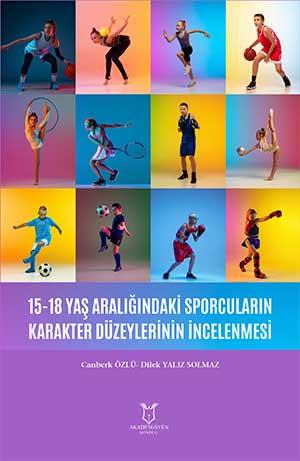
Canberk Özlü ve Dilek Yalız Solmaz tarafından kaleme alınan ve Akademisyen Kitabevi tarafından yayımlanan "15-18 Yaş Aralığındaki Sporcuların Karakter Düzeylerinin İncelenmesi" başlıklı bu eser, genç sporcuların spordaki ahlaki ve karakter gelişimlerini çeşitli demografik ve sportif değişkenler açısından derinlemesine ele almaktadır. Nicel araştırma yaklaşımlarından genel tarama modelinin kullanıldığı çalışmada, Kayseri ilinde lisanslı olarak spor yapan 15-18 yaş aralığındaki 405 gönüllü sporcudan Kişisel Bilgi Formu ve Spor Karakter Ölçeği vasıtasıyla veriler toplanmıştır. Araştırma bulgularına göre, cinsiyet değişkeni genel spor karakteri, dürüstlük, merhamet, sportmenlik ve adalet boyutlarında anlamlı bir fark yaratmazken; anti-sosyal davranış alt boyutunda kız sporcuların erkeklere kıyasla anlamlı derecede daha olumlu bir tutuma sahip olduğu belirlenmiştir. İlgilenilen spor türü incelendiğinde, bireysel sporlarla uğraşan sporcuların dürüstlük alt boyut puanlarının takım sporu yapanlara göre istatistiksel olarak anlamlı düzeyde yüksek olduğu tespit edilmiştir. Ayrıca akademik not ortalaması arttıkça anti-sosyal davranış sergileme eğiliminin azaldığı görülmüştür. Buna karşın; sporcuların yaşı, öğrenim gördükleri sınıf düzeyi, milli olma durumları, spor yapma süreleri ile anne ve babalarının eğitim düzeylerinin karakter düzeyleri üzerinde anlamlı bir farklılık oluşturmadığı saptanmıştır. Çalışma, gençlik sporlarında karakter ve değer eğitiminin müfredatlara ve antrenör eğitimlerine entegre edilmesine yönelik önemli öneriler sunmaktadır.
Authored by Canberk Özlü and Dilek Yalız Solmaz and published by Akademisyen Kitabevi, "15-18 Yaş Aralığındaki Sporcuların Karakter Düzeylerinin İncelenmesi" (Investigation of Character Levels of Athletes Aged 15-18) thoroughly examines the moral and character development of young athletes in relation to various demographic and sports variables. Employing a general survey model from quantitative research methodologies, the study collected data from 405 licensed volunteer athletes aged 15-18 in Kayseri Province using a Personal Information Form and the Sport Character Scale. According to the research findings, while gender created no significant difference in overall sport character, integrity, compassion, sportspersonship, or fairness dimensions, female athletes exhibited a significantly more positive attitude (lower anti-social behavior) compared to males in the anti-social behavior sub-dimension. When analyzing the type of sport, athletes participating in individual sports scored significantly higher in the integrity sub-dimension than team sport athletes. Additionally, higher academic Grade Point Averages were associated with a decrease in anti-social behavior tendencies. Conversely, factors such as age, grade level, national athlete status, athletic experience duration, and parents' educational background showed no statistically significant impact on character levels. The work offers key recommendations for integrating character and values education into curricula and coaching training programs in youth sports.
Referanslar
Addis, A. (1996). Role models and the politics of recognition. Pennsylvania Law Review, 144(4), 1377-1468.
Adır, Y. (2017). Fiziksel etkinlik oyunlarının ortaöğretim düzeyindeki öğrencilerin karakter gelişimi düzeylerine etkisi. Aksaray: Aksaray Üniversitesi, Sosyal Bilimler Enstitüsü Yüksek Lisans Tezi.
Akandere, M., Baştuğ, G., & Güler, D. E. (2009). Orta öğretim kurumlarında spora katılımın çocuğun ahlaki gelişimine etkisi. Niğde Üniversitesi Beden Eğitimi ve Spor Bilimleri Dergisi, 3(1), 59-68.
Arnold, P. (1994). Sport and Moral Education. Journal of Moral Education, 23(1), 75-90.
Arnold, P. (1999). The Virtues, moral education and the practice of sport. Quest, 51(1), 39-54.
Arslan, B. (2018). Türkiye'deki Bocce ve Dart Sporcularının Ahlaki Karar Alma Tutumlarının İncelenmesi. Bartın Üniversitesi, Eğitim Bilimleri Enstitüsü, Beden Eğitimi ve Spor Ana Bilim Dalı Yüksek Lisans Tezi.
Ashmore, R. (1987). Building a moral system. Englewood Cliffs, NJ: Prentice Hall.
Atalay, A. (2016). Türkiye'de Üniversitelerde Eğitim Gören Öğrenci-Sporcuların Ahlaki Karar Alma Tutumları. Akademik Sosyal Araştırmalar Dergisi, 3(1) 53-61.
Baer, J. (1999). Adolescent development and the junior high school enviorenment. Social Work in Education, 21(2) 238-248.
Bandura, A., Ross, D., Ross, S. (1961). Transmission of aggression through imitation of aggressive models. Journal of Abnormal and Social Psychology, 63(4), 575-582.
Barriga, A., Morrison, E., Liau, A., Gibbs, J. (2001). Moral cognition: Explaining the gender difference in anti social behavior. Merrill-Palmer Quarterly, 47(1), 532-562.
Beckner, W. (2004). Ethics for educational leaders. Boston: Pearson Education.
Beller, J. (2002). Positive character development in school sport programs. Washington: Clearinghouse on Teaching and Teacher Education.
Beller, J., & Stoll, S. K. (1995). Moral reasoning of high school student athletes and general studentns: An empirical study versus personal testimony. Pediatric Exercise Science, 4(1), 352-363.
Berkowitz, M. (2002). The Science of Character Education. In: Bringing in a New Era in Character Education. William Demon (Edit). Stanford, California: Hoover Institution Press.
Berkowitz, M., Grych, J. (2000). Early character development and education. Early Education and Development, 11(1), 55-72.
Bernstein, L. (2008). Yes, I can. Current Health, 32(2), 26-29.
Bjorklund, D. (1995). Children's thinking. Pacific Grove, CA: Brooks & Cole.
Blum, D. (1995). Coaches as role models [Electronic version]. Chronicle of Higher Education, 41(1), 35-46.
Boardley, D., Kavussanu, M. (2009). The Influence of Social Variables and Moral Disengagement on Prosocial and Antisocial Behaviour in Field Hockey and Netball. Journal of Sports Science, 12(2), 843-854.
Boshwort, K. (1995). Caring for others and being cared for. Phi Delta Kappan, 76(4), 686-693.
Böyükelhan, E., Özdilek, Ç., Kaya, T., Yağmur., Ö. M. (2019). Bazı Değişkenlere Göre Öğrenci Sporcuların Ahlaki Karar Alma Tutumlarının İncelenmesi. Spormetre, 16(4), 172-184
Bredemeier, B. (1994). Childrens's moral reasoning and their assertive, aggressive and submissive tendencies in sport and daily life. Journal of Sport and Exercise Psychology, 16(5), 1-14.
Bredemeier, B. J., Weiss, M., Shields, D., Cooper, B. (1987). The Relationship between children's legitimacy judgments and their moral reasoning, aggressions tendencies and sport involvement. Sociology of Sport Journal, 4(1), 48-60.
Bredemeier, B., Shields, D. (1984). Divergence in children's moral reasoning about issues in daily life and sport spesific contexts. International Journal of Sport Psychology 26(6), 453-463.
Bredemeier, B., Shields, D. (1986). Athletic aggression: An issue of contextual morality. Sociology of Sport Journal 3(8), 15-28.
Bredemeier, B., Shields, D. (1986). Game reasoning and interactional morality. Journal of Genetic Psychology, 147(2), 257-270.
Bredemeier, B., Shields, D. (1995). Character Development and Physical Activity. New York: Human Kinetics.
Brody, S., Siegel, M. (1992). The evolution of character. Madison, CT: International Universities Press, Inc.
Bronfenbrenner, U. (1977). Toward and experimental ecology of human development. American Psychologist, 37(5), 513-531.
Büyüköztürk, Ş. (2016). Bilimsel Araştırma Yöntemleri. Ankara: Pegem Akademi Yayıncılık.
Carlo, G., Fabes, R., Laible, D., Kupanoff, K. (1999). Early adolesence and prosocial/Moral behavior II: The role of social and contextual influences. Journal of Early Adolesence, 19(1), 133-147.
Chandler, T., Goldberg, A. (1990). Building character through sports: Myth or possbility? Counseling and Values, 34(2), 169-176.
Coakley, J. (1998). Sport and society: Issues of controversises. St. Louis, MO: C. V. Mosby.
Coakley, J. (2007). Sport in society: Issues and controversies. New York: McGraw-Hill.
Conroy, D., Silva, J., Newcomer, R., Walker, B., Johnson, M. (2001). Personal and participatory influences on socialization of aggressive sport behavior. Agressive Behavior, 3(1), 405-418.
Çıngı, H. (1994). Örnekleme Kuramı (İkinci baskı). Ankara: Hacettepe Üniversitesi Basımevi.
Dada, B. (2016). Sportsmanship development strategies for coaches of university athletes in south-Nigeria. Journal of Education and Practice, 7(14), 104-112.
Damon, W. (1995). The moral child. New York: Free Press.
Damon, W., Gregory, A. (1997). The youth charter: Towards the formation of adolescent moral identity. Journal of Moral Education, 26(1),117-130.
d'Arripe, L. F., Corrion, K., Scoffier, S., Roussel, P., Chalabaev, A. (2010). Sociocognitive Self-Regulatory Mechanisms Governing Judgments of the Acceptability and Likelihood of Sport Cheating. Journal of Sport and Exercise Psychology, 8(2), 595-618.
de Coubertin, P. (1988). Why I revived the Olympic games. Champaign, IL: Human Kinetics.
Destebaşı, F. (2011). Çocuk Edebiyatı Eserlerinin 7 ve 8. Sınıf Öğrencilerinin Karakter Gelişimine Etkisi. Abant İzzet Baysal Üniversitesi, Sosyal Bilimler Enstitüsü, Yüksek Lisans Tezi, Bolu.
Diamond, A., Lee, K. (2011). Interventions shown to aid executive function development in children 4 to 12 years old. Science, 333(6045), 959-964.
Doty, J. (2006). Sports Build Character. Journal of Collage and Character, 7(1), 1-9.
Eitzen, D., Sage, G. (2003). Sociology of North American Sport. New York: McGraw-Hill.
Ekşi, H., Katılmış, A. (2011). Karakter Eğitimi El Kitabı. Ankara: Nobel Yayınları.
Engh, F. (1999). Why Johnny hates sports. Garden City Park, NY: Avery Publishing Group.
Fleming, S., Hardman, S., Jones, C., Sheridan, H. (2005). Role models among elite young male rugby league players in Britain. Eurupean physical education review. 11(1), 51-70.
Franken, W. K. (1973). Ethics (2nd Ed.). Englewood Cliffs, NJ: Practice Hall.
Fromm, E. (1993). Erdem ve Mutluluk: Ahlak Psikolojisi Üzerine Bir İnceleme, (Çev: Ayda Yörükan). İstanbul: Türkiye İş Bankası Kültür Yayınları.
Fromm, E. (1996). Kendini Savunan İnsan (Çev: Necla Arat). İstanbul: Say.
Funk, C., Shields, D., Bredemeier, B. L. (2016). Contesting orientations, self-determined motivation and sportpersonship: Further validation of the contesting orientations scale. Psychology of Sport and Exercise, 27(2), 66-77.
Gargano, M. (2001). A Study to determine whether or not the principles of sportsmanship and ethical conduct can co-exist with the competing principles associated with highly competitive athletic programs in NCAA Divison 1 men's basketball. (Unpublished Doctoral Dissertation, George Washington University, USA).
George, D., Mallery, M. (2010). SPSS for Windows Step by Step: A Simple Guide and Reference. Boston: Allyn & Bacon.
Gibbons, S., Ebbeck, V., Weiss, M. (1995). Fair Play For Kids:Effects on the moral development of children in physical education. Research Quarterly for Exercise and Sport 66(1), 247-255.
Giuliano, T., Turner, K., Lundquist, J. C., Knight, J. (2007). Gender and the selection of public athletic role models. Journal of Sport Behavior. 30(2), 161-174
Goldschmidt, W. (1953). Values and the field of comparative sociology. American Sociological Review, 18(1), 287-293.
Gough, R. (1997). Character is everything: Promoting ethical excellence in sport. Orlando, FL: Harcourt Brace College Publishers.
Görgüt, İ. (2015). Ortaokullarda görev yapan beden eğitimi ve diğer branş öğretmenlerinin ahlak, karakter ve değerler eğitimine ilişkin görüşlerinin incelenmesi. Ankara: Gazi Üniversitesi, Eğitim Bilimleri Enstitüsü, Doktora Tezi.
Görgüt, İ., Tuncel, S. (2017). Spor Karakter Ölçeğinin Türkçe Uyarlaması. Spormetre, 15(3), 149-156.
Guest, A., Cox, S. (2009). Using athletes as rol models? Conceptual and empirical perpective from a sample of elite women soccer players. International Journal of Sport, Science and Coaching, 4(4), 567-581.
Guivernau, M., Duda, J. (2002). Moral atmosphere and athletic aggressive tendencies in young soccer players. Journal of Moral Education, 31(2), 67-85.
Gump, J. (2007). War chiefs In D.J. Wishart (Ed.) Encylopedia of Great Plains Indians s. 216. Bison, NE: University of Nebraska Press.
Gündoğdu, F. (2010). Ortaöğretim Kurumlarında Karakter Eğitimi Sorunu (Kayseri İli Örneği). Yüksek Lisans Tezi, Erciyes Üniversitesi, Sosyal Bilimler Enstitüsü, Kayseri.
Güngör, E. (2000). Ahlak Psikolojisi ve Sosyal Ahlak. İstanbul: Ötüken Yayıncılık.
Gürpınar, B. (2014). Attitudes to Moral Decision Making of the Student Athletes in Secondary and High School Level According to Sport Variables. Education and Science, 39(1), 413-424.
Güvendi, B., Işım, A. (2019). Moral Disengagement and Aggression in Fight Sport Athletes. Journal of Education and Training Studies, 7(7), 118-123.
Haan, N. (1978). Two moralities in action contexts: Relationship thought. Journal of Personality and Social Psychology, 36(4), 286-305.
Haan, N. (1991). Moral Development and Action From a Social Constructivist Perspective. W. Kurtines, & J. Gewirtz. içinde, The handbook of moral behavior and development (s. 251-273). Hillside, N.J.: Lawrence Erlbaum Associates.
Hart, D., Atkins, R. (1999). Family influences on the formation or moral identity in adolesence: Longitidunal analyses. Journal of Moral Education, 28(2), 375-386.
Hartshorne, H., May, M. (1928). Studies in the nature of character: Studies in deceit (Vol.1). New York: The Mcmillan Company.
Hodge, K., Tod, D. (1993). Ethics of childhood sport. Sport Medicine, 15(4), 291-298.
Humpries, M., Parker, B. (2000). Predictors of moral reasoning among African American children: A preliminary study. Journal of Black Psychology, 26(2), 51-64.
İmamlı, H., Ünver, G. (2018). Sport Karakterinin Demografik Nitelikler Açısından İncelenmesi. Akdeniz Spor Bilimleri Dergisi, 1(1) 36-49.
Jakubowski, J. K. (2013). Making Character Education a reality: an investigation of secondary teachers' perpectives toward implementation (Doctoral dissertation, Arizona State University, USA).
Jang, Y. C. (2013). Development and the validation of sport character scale (Doctoral dissertation, The University of Utah, USA).
Jones, C., McNamee, M. (2000). Moral reasoning, moral action and the moral atmosphere of sport. Sport, Education and Society, 5(1) 131-146.
Karasar, N. (2016). Bilimsel Araştırma Yöntemi. Ankara: Nobel Akademik Yayıncılık.
Karpova, S., Murzinova, N. (1990). The importance of play and schoolwork in the assimilation of norms by 6-7 years old. Soviet Psychology, 28(4), 56-65.
Kavussanu, M., Roberts, G. C. (2001). Moral Functioning in Sport: An Achievement Goal Perspective. Journal of Sport and Exercise Psychology, 8(3), 37-54.
Kavussanu, M., Stamp, R., Slade, G., Ring, C. (2009). Observed Prosocial and Antisocial Behaviours in Male and Female Soccer Players. Journal of Applied Sport Psychology, 4(1), 62-76.
Kaymakcan, R., H., M. (2012). Ahlaki Karakter ve Eğitimi. 2. Uluslararası Değerler Eğitimi ve Sempozyumunda sunulmuş bildiri, İstanbul.
Kent, M. (2006). The Oxford Dictionary of Sports Science&Medicine (3 ed.). Oxford, UK: Oxford University Press.
Kerschensteiner, G. (1977). Karakter Kavramı ve Terbiyesi (Çev: Fikret Kanad). Ankara:Say.
Kohak, E. (1994). Being human more or less. Human Studies, 21(4), 287-305.
Kohlberg, L. (1964). Development of moral character and ideology. New York: Russel Sage Foundation.
Kohlberg, L. (1981). The Philosopyh of moral development: Moral stages and the idea of justice. New York: Harper&Row Publishing.
Köknal, Ö. (1982). Kaygıdan Mutluluğa Kişilik. İstanbul: Altın Kitaplar.
Lakes, K., Hoyt, W. (2004). Promoting self-regulation through school-based martial arts training. Applied Developmental Psychology, 25(5), 283-302.
Larson, R. (2000). Toward a psychology of positive youth development. American Psychologist, 55(4), 170-183.
Leonard, H. (1997). The many faces of character. Counseling Psychology Journal:Practice, 49(1), 235-245.
Levy, K. (1997). Multifactorial self-consept and delinquency in Australian adolescents. Journal of Social Psychology, 137(1), 277-283.
Lickona, T. (1991). Educating for character. New York: Bantam Books.
Lines, G. (2001). Villains, fools or heroes? Sport stars as role models for young people. Leisure Studies, 20(6), 285-303.
Lirgg, C. D. (1991). Gender Differences in Self-Confidence in Physical Activity: A Meta-Analysis of Recent Studies. Journal of Sport and Exercise Psyhcology, 5(1), 294-310.
Lounsburry, J., Fisher, L., Levy, J., Welsh, D. (2009). An Investigation of Character Strengths in Relation to the Academic Success of College Students. Individual Differences Research, 7(1), 52-69.
Martin, E., Gould, D., Ewing, M. E. (2015). Youth's Perceptions of Rule-Breaking and antisocial behaviours: Gender, Developmental level and Competitive Level Differences. International Journal of Sport and Exercise Psyhcology, 1(3), 1-16.
Maslow, A. (1970). Motivation and personality. New York: Harper & Row.
McCloy, C. (1936). A factor analysis of personality traits to underlie character education. The Journal of Educattional Psychology, 27(4), 375-387.
Miller, B., Roberts, G., Ommundsen, Y. (2005). Effect of perceived motivational climate on moral functioning, team moral atmosphere perceptions, and the legitimacy of intentionally injurious acts among competitive youth football players. Psychology of Sport and Exercise, 3(3) 461-477.
Miller, R., Jarman, B. (1988). Moral and etcihal character development views from past leaders. Journal of Physical Education, Recration and Dance, 56(4), 72-78.
Muir, K., Seitz, T. (2004). Machismo, misogyny and homophobia in a male athletic subculture: A participant-observation study of deviant rituals in collgiate rugby. Deviant Behavior, 25(5), 303-327.
O'Hanlon, T. (1980). Interscholastic athletics, 1900-1940: Shaping citizens for unequal roles in the modern industrial state. Educational Theory, 30(2), 80-103.
Okin, S., Reish, R. (1999). Families and schools as compensating agents in moral development for a multicultural society. Journal of Moral Education, 28(2), 284-299.
Ommundsen, Y., Roberts, G., Lemyre, P., Treasure, D. (2003). Perceived motavational climate in male youth soccer; Relations to social-moral functioning, sportspersonship and team norm perceptions. Pyhcology of Sport and Exercise, 4(4) 397-413.
Otto, L., Atkinson, M. (1997). Parental involvement and adolescant development. Journal of Adolescent Research, 12(1), 68-79.
Öztürk, A. V. (2018). Vücut geliştirme ve bilek güreşi müsabık sporcularının sportif ahlaki yaklaşımları ile karakter düzeylerinin incelenmesi. Antalya: Akdeniz Üniversitesi, Sağlık Bilimleri Enstitüsü Yüksek Lisans Tezi.
Passmore, B. (2008). Orient Success. The Times Educational Supplement, 4(1), 18-20.
Perrottet, T. (2004). The naked Olympics: The true story of the ancient games. New York: Random House Inc.
Pratt, M., Arnold, M., Pratt, A., Diessner, R. (1999). Predicting adolescent moral reasoning from family climate: A longitudinal study. Journal of Early Adolesence, 19(1), 148-175.
Priest, R., Krause, J., Beach, J. (1997). Four-year challenges in college athletes' ethical value choices in sport situations. Research Quarterly For Exercise And Sport, 70(2), 170-178.
Priest, R., Krause, J., Beach, J. (2006). Four-Year Changes in college athletes' ethical value choices in sport stiuations. Research Quarterly for Exercise and Sport 70(1), 170-178.
Richard, D. (1999). Are women more ethical? Recent findings on the effect of gender upon moral development. Journal of Public Administration Research and Theory, 9(3), 459-472.
Rudd, A. (1998). Sport's perceived ability to build character (Unpublished doctoral dissertation, University of Idaho at Moscow.
Rudd, A. (2008). A qualitative study on the moral reasoning of college athletes. Journal of Coaching Education, 1(3), 1-27.
Rudd, A., Stoll, S. (2004). Whay type of character do athletes possess? An emprical examination of college atheletes versus college non-athletes with RSBH Value Judgment Inventory. The Sport Journal, 7(2), 1-10.
Sage, G. (1998). Does sport affect character development in ahtletes. New York: Oxford University Press.
Schaeffer, E. (1997). Knowledge without character=incomplete education. NAESP Principal Online.
Segrave, J., Chu, D. (1988). The Olympic games in transition. Champaign, IL: Human Kinetics.
Sherman, N. (2005). Stoic warriors: The ancient philosphy behind the military mind. New York: Oxford University Press.
Shields, D. L., Bredemeier, B. L., LaVoi, N. M., Power, F. C. (2005). The Sport Behavior of Youth, Parents and Coaches. Journal of Research in Character Education, 3(1), 43-59.
Shields, D., Bredemeier, B. (2005). Can sports build character? D.K Lapsley & F.C. Tower (Eds.). Notre Dame, IN: University of Notre Dame Press.
Shopcott, K., Bloom, G., Loughead, T. (2007). Factors influencing aggressive and assertive intentions of women ice hockey players. International Journal of Sport Psychology, 38(6), 145-162.
Siegenthaler, K., Gonzales, G. (1997). Youth sports as serious leisure: A critique. Journal of Sport & Social Issues, 21(4), 298-314.
Siyahtaş, A., Saraç, D, Tükenmez, A., Hocaoğlu, M. (2018). Farklı Branşlardaki Sporcuların Spor Karakter Özelliklerinin Karşılaştırılması. International Social Studies Journal, 28(5) 6252-6259.
Smith, V. (1997). The effects of caring on the achievement of African American males. Challenge, 8(1), 1-15.
Spinard, T., Losoya, S. (1999). The relations of parental affect and encouragement to children's moral emotions and behavior. Journal of Moral Education, 28(9), 323-327.
Stephens, D. E., Bredemeier, B. J. (1996). Moral atmosphere and judgments about aggression in girls' soccer: Relationships among moral and motivational variables. Journal of Sport and Exercise Psychology, 18(1), 158-173.
Stoll, S. (2012). The Effects of Athletic Competetion on Character Development in College Student Athletes. Journal of College and Character, 13(4), 45-59.
Stoll, S., Beller, J. (1998). Sport as education: On the edge. New York, NY: Columbia University: Teacher Press.
Stupuris, T., Suksy, S., Tilindiene, I. (2013). Relationship between adolescent athletes' values and behavior in sport perceived coach's character development competency. Lithuanian Academy of Physical Education, 4(9), 37-45.
Teo, R. W. (2010). The Effectiveness in Measuring Character Development Outcomes in Singopore Schools through Character Development Award (Doctoral dissertation, Dunham University, UK).
Tofler, I., Butterbaugh, G. (2005). Developmental overview of child and youth sports for the twenty-first century. Clinics in Sport Medicine, 24(5), 783-804.
Traclet, S., Romand, P., Moret, O., Kavussanu, M. (2011). Antiosocial behavior in soccer: A qualitative study of moral disengagement. International Journal of Sport and Exercise Psycholgy, 9(2), 143-155.
Uysal, F. (2008). Karakter Eğitimi Programlarının Değerlendirilmesi. Yüksek Lisans Tezi, Yeditepe Üniversitesi, Sosyal Bilimler Enstitüsü, İstanbul.
Visek, A., Watson, J. (2005). Ice hockey players' legitimacy of aggression and professionalization of attitudes. The Sport Psychologist, 19(3), 178-192.
Vogler, C., Schwartz, S. (1993). The sociology of sport: An introduction. New Jersey: Prentice-Hall Inc.
Watt, S., Moore, J. (2001). Who are student athletes? New Directions for Student Services, 93(5), 7-18.
Yalız, D. (2011). Beden eğitimi dersi kapsamındaki fiziksel etkinlik oyunlarının ilköğretim öğrencilerinin karakter gelişimleri üzerindeki etkisi. Anadolu Üniversitesi, Sağlık Bilimleri Enstitüsu, Doktora Tezi.
Yapan, H. (1992). Spor Ahlakı; Beden Eğitimi Dersinde Ahlaki Eğitim. Marmara Üniversitesi Sağlık Bilimleri Enstitüsü Beden Eğitimi ve Spor Anabilim Dalı Yüksek Lisans Tezi.
Yogan, L. (2000). School tracking and studen violence. Annal of the American Academy of Political & Social Science, 567(1), 108-122.
Yayınlanan
Lisans
LisansBu İnternet Sitesi içeriğinde yer alan tüm eserler (yazı, resim, görüntü, fotoğraf, video, müzik vb.) Akademisyen Kitabevine ait olup, 5846 sayılı Fikir ve Sanat Eserleri Kanunu ve 5237 sayılı Türk Ceca Kanunu kapsamında korunmaktadır. Bu hakları ihlal eden kişiler, 5846 sayılı Fikir ve Sanat eserleri Kanunu ve 5237 sayılı Türk Ceza Kanununda yer alan hukuki ve cezai yaptırımlara tabi olurlar. Yayınevi ilgili yasal yollara başvurma hakkına sahiptir.