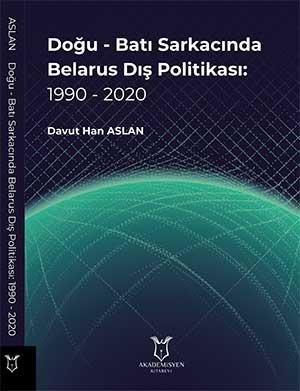
Doğu - Batı Sarkacında Belarus Dış Politikası: 1990 - 2020
Özet
Davut Han ASLAN tarafından kaleme alınan Doğu - Batı Sarkacında Belarus Dış Politikası: 1990-2020, Soğuk Savaş sonrası dönemde bağımsız bir aktör olarak uluslararası sistemde yerini alan Belarus Cumhuriyeti'nin dış politika kurgulama stratejilerini, temel yönelimlerini ve karar alma süreçlerini 1990-2020 yılları arasındaki otuz yıllık süreçte kapsamlı şekilde incelemektedir. Kitap, Baltık Denizi ile Karadeniz arasındaki stratejik kesişim noktasında bulunan ülkenin güvenlik ve dış politika tercihlerini; Realizm, İnşacılık, Orta Büyüklükte Devlet teorisi, Asimetrik Karşılıklı Bağımlılık ve Liderlik Profili Analizi gibi kuramsal ve kavramsal yaklaşımlar ışığında irdelemektedir. 1994 yılında iktidara gelen Aleksander Lukaşenko yönetimi, Sovyet nostaljisi, Rusya Federasyonu ile kurulan Birlik Devleti eksenli asimetrik angajmanlar ve Batı yaptırımları neticesinde Asya, Latin Amerika ve Ortadoğu ülkelerine doğru yönelen çok yönlü (multi-vektörel) dış politika denge arayışları üzerinden detaylandırılmaktadır. Tarihsel kökenlerden başlayarak Perestroyka dönemi, SSCB'nin dağılması, nükleer silahsızlanma, komşu ülkelerle ilişkiler, Rusya ile yaşanan ticaret savaşları, Avro-Maidan sonrası süreç ve 2020 Devlet Başkanlığı Seçimleri ile gelişen toplumsal kırılmalar kronolojik bir hiyerarşiyle ele alınmaktadır. Türkçe akademik literatürde Doğu Avrupa ve Belarus dış politikası üzerine yazılmış en kapsamlı ilk özgün eser olma niteliği taşıyan bu çalışma, uluslararası ilişkiler, Avrasya jeopolitiği ve Doğu Avrupa alanında araştırma yapan okurlar için vazgeçilmez bir temel başvuru kaynağıdır.
Authored by Davut Han ASLAN, Belarus Foreign Policy in the Pendulum of East and West: 1990-2020 comprehensively examines the foreign policy strategies, main orientations, and decision-making processes of the Republic of Belarus—which took its place in the international system as an independent actor in the post-Cold War era—spanning the thirty-year period between 1990 and 2020. Located at a strategic intersection between the Baltic Sea and the Black Sea, the book explores the country's security and foreign policy preferences through theoretical and conceptual approaches such as Realism, Constructivism, Middle Power theory, Asymmetric Interdependence, and Leadership Profile Analysis. The leadership of Aleksander Lukashenko, who came to power in 1994, is detailed through the lenses of Soviet nostalgia, asymmetric engagements centered on the Union State with the Russian Federation, and multi-vector foreign policy balancing attempts towards Asia, Latin America, and the Middle East in response to Western sanctions. Starting from historical origins, the work chronologically analyzes the Perestroika era, the dissolution of the USSR, nuclear disarmament, relations with neighboring states, trade wars with Russia, post-Euro-Maidan developments, and societal shifts following the 2020 Presidential Elections. Standing out as the first comprehensive original study written on Eastern Europe and Belarusian foreign policy in Turkish academic literature, this work serves as an indispensable reference guide for researchers interested in international relations, Eurasian geopolitics, and regional politics.
Referanslar
Abdelal, Rawi. “Belarus: Toward Russia and the East”, Ed National Purpose in the World Economy, Cornell University Press, New York, 2005.
Aktürk, Şener. “NATO Neden Genişledi? Uluslararası İlişkiler Kuramları Işığında NATO’nun Genişlemesi ve ABD - Rusya İç Siyaseti”, Uluslararası İlişkiler Dergisi, Yaz, 9, 34, 2012.
Al-Haj, Majid. Immigration and Ethnic Formation in a Deeply Divided Society: The Case of the 1990s Immigrants from the Former Soviet Union in Israel, Brill, Leiden, 2004.
Andryiashka, Maryna. “National Security of the Republic of Belarus: Legal Regulation of Eight Different Areas”, Studia Sieci Uniwersytetów Pogranicza, Vol. 3.
Anık, Cengiz. Siyasi Rejimler ve Kamuoyu, Selçuk İletişim, 2014.
Applebaum, Anne. Red Famine: Stalin's War on Ukraine, Penguin Books, USA, 2018.
Aradau, Claudia. “Security and the Democratic Scene: Desecuritization and Emancipation”, Journal of International Relations and Development, Volume 7., 2004.
Ash, Konstantin. “The Election Trap: The Cycle of Post-Electoral Repression and Opposition Fragmentation in Lukashenko’s Belarus”, Democratization, 2015.
Aslan, Davut Han Sevde Işılak, “Russia - Turkey Energy Relations after 2002: The Asymmetry of Interdependence”, Społeczeństwo i Polityka, 2020.
Astapova, Anastasiya. "Political Biography: Incoherence, Contestation, and Elements of the Hero Pattern in the Belarusian Case", Journal of Folklore Research, Vol. 53, No. 2, May/August, 2016.
Aydın, Mustafa. “Uluslararası İlişkilerde Yaklaşım, Teori ve Yaklaşım”, Ankara Üniversitesi SBF Dergisi, Cilt 51, Sayı 1, 1996.
Balmaceda, Margarita M. Living the High Life in Minsk : Russian Energy Rents, Domestic Populism and Belarus' Impending Crisis, Central European University Press, Budapest, 2014.
Barber, James David. Presidential character: Predicting performance in the White House, Englewood Cliffs, NJ, Prentice, Hall, 1992.
Bazan, Lubov.A History of Belarus: A Non - Literary Essay that Explains the Ethnogenesis of Belarus, Glagoslav Publication, United Kingdom, 2020
Bedford, Sofie. “The 2020 Presidential Election in Belarus: Erosion of Authoritarian Stability and Re-politicization of Society”, Nationalities Papers, 49: 5, 2021.
Beorn, Waitman Wade Marching into Darkness: The Wehrmacht and the Holocaust in Belarus, Harvard University Press, New York, 2014.
Bekus, Nelly. Struggle Over Identity: The Official and The Alternative Belarussiness, Central European Press, Budapest, 2013.
Bekus, Nelly. “Hybrid” Linguistic Identity of Post-soviet Belarus”, Journal of Ethnopolitics and Minority Issues in Europe, 13(4), 2014.
Bennet, Brian. The Last Dictatorship in Europe: Belarus Under Lukashenko, Hurst and Co. Publishing Ltd, London, 2011.
Bieleń, Stanisław. “Kierunki polityki wschodniej III RP” Ed.Stanisław Bieleń, Patrząc na Wschód. Z Problematyki Polityki Wschodniej III RP, Warszawa 1997.
Brzeziński, Zbigniew The Grand Chessboard American Primacy and Its Geostrategic Imperatives, Perseus Books L.L.C., 1997.
Brzezinski, Zbigniew. Büyük Satranç Tahtası: Amerika’nın Küresel Üstünlüğü ve Bunun Jeostratejik Gereklilikleri, İnkılap Kitabevi, İstanbul, 2005.
Buszynski, Leszek. Russian Foreign Policy After the Cold War, Greenwood Publishing Group, Westport, 1996.
Chapnick, Adam. “The Middle Power”, Canadian Foreign Policy Journal, No 2., 1999.
Cheskin, Ammon & Angela Kachuyevski, “The Russian-Speaking Populations in the Post-Soviet Space: Language, Politics and Identity ”, Europe-Asia Studies, Volume 71, Issue 1, 2019.
Chomsky, Noam. Hegemony or Survival America's Quest for Global Dominance, Penguin Books Ltd, London, 2004.
Crowards, Tom. “Defining the Category of ‘Small’ States”, Journal of International Development, No 2, 2002.
Citko, Lilia. Piśmiennictwo i Nazewnictwo Starobiałoruskie na Ziemiach Wielkiego Księstwa Litewskiego: Wybrane Problemy, Wydawnictwo Uniwersytetu w Białymstoku, Białystok,2019.
Cooper, Leo, Russia and the World, New State-of-Play on the International Stage, New York, St. Martin’s Press, Inc., 1999.
Czachor, Rafał. Polityka zagraniczna Republiki Białoruś w latach 1991- 2011, Wydawnictwo Dolnośląskiej Wyższej Szkoły Przedsiębiorczości i Techniki w Polkowicach, Polkowice, 2011.
Czachor, Rafał. Transformacja Systemu Politycznego Białorusi w latach 1988-2001, Wydawnictwo Uczelni Jana Wyżykowskiego, Polkowice, 2016.
Danilovich, Alex. Russian - Belarussian Integration, Ashgate Publishing, Farnham, 2020.
Davies, Norman. Boże Igrzysko: Historia Polska, Społeczny Instytut Wydawniczy Znak, Warszawa, 2010.
Dawson, Andrew ve Fawn, Rick. “The Changing Geopolitics of Eastern Europe: An Introduction ”, Geopolitics, 6:1, 2001.
Demirci, Levent. “Özbekistan, Kırgızistan ve Tacikistan’ın Kesişimindeki Sorunlu Vadi: Fergana”, Savunma Bilimleri Dergisi, Kasım/November, Cilt/Volume 11, Sayı/Issue 2. 2012.
Duverger, Maurice. Seçimle Gelen Krallar, Konuk Yayınları, İstanbul, 1975.
Eigner, Johannes. “Relations between EU and Belarus”, Ed. Hans-Georg Heinrich ve Ludmilla Lobova, Belarus: External Pressure, Internal Change, Peter Lang, Frankfurt am Main, Berlin, Bern, Bruxelles, New York, Oxford, Wien, 2009.
Esin, Ruslan. “Belarus - Japan: New Opportunities Under New Regional Conditions”, Journal of the Belarusian State University, International Relations. 2017. No. 2.
Eke, Steven, Taras Kuzio, “Sultanism in Eastern Europe: The Socio - Political Roots of Authoritarian Populism in Belarus”, Europe - Asia Studies, 52, 2000.
Felkay, Andrew. Yeltsin’s Russia and the West, London, Praeger, 2002.
Fritz, Verena. State-Building: A Comparative Study of Ukraine, Lithuania, Belarus, and Russia, Central European University Press, Budapest, 2007.
Gaidar, Yegor. Days of Defeat and Victory, University of Washington Press, Washington, 1999.
Garthoff, Raymond. The Great Transition, Brookings, Washington, 1994.
Gökırmak, Mert. “Beyaz Rusya’nın Denge Stratejisi ve Rus Dış Politikasına Etkisi”, Güvenlik Stratejileri Dergisi, Cilt 6, Sayı 12, 2010.
Gross, Jan. Tomasz Revolution from Abroad: the Soviet Conquest of Poland’s Western Ukraine and Western Belorussia, Princeton University Press, Princeton, 1988.
Harrison, Ewan. The Post-Cold War International System, New York, Routledge, 2004.
Heradstveit, v ve G. Matthew Bonham. “What the Axis of Evil Metaphor Did to Iran”, Middle East Journal, Vol. 61, No. 3, Summer, 2007.
Herz, John H. “Idealist Internationalism and the Security Dilemma”, World Politics, Cilt 2, 1950.
Holmes, Leslie. Post - Communism: An Introduction, Cambridge Press, Cambridge, 1997.
Hüseynov, Fuad “Bağımsız Devletler Topluluğu'nun Oluşumunun Hukuki Boyutları”, Ankara Üniversitesi Hukuk Fakültesi Dergisi, Volume 52, Issue 4, 2003.
Ioffe, Grigory. Reassessing Lukashenka, Palgrave Macmillan, London, 2014.
Judt, Tony. “The Dilemmas of Dissidence: the Politics of Opposition in East Central Europe”, in F. Fehér and A. Arato (eds), Crisis and Reform in Eastern Europe, Transaction Publishers, New Brunswick, 2003.
Kamusella, Tomasz.“Germanization, Polonization, and Russification in the partitioned lands of Poland-Lithuania”, Nationalities Papers: The Journal of Nationalism and Ethnicity, Cilt.41, S.5, 2013.
Kan, Kürşat. Dış Politikada Liderlik, Çizgi Kitabevi, İstanbul, 2017.
Karaś, Halina. Rusycyzmy Słownikowe w Polszczyźnie Okresu Zaborów, Warszawa,1996.
Kaya, Güler. Soğuk Savaş Sonrası Eski SSCB Coğrafyasında Etnik ve Dinsel Çatışmalar, Berikan Yayınları, İstanbul, 2013.
Keohane, Robert ve Joseph S. Nye, Power and Interdependence, Addison Wesley Longman, New York, 2001.
Keohane, Robert ve Joseph S. Nye, “Power and Interdependence in the Information Age”, Foreign Affairs, Cilt 77, No 5, 1998.
Keohane, Robert O. “Lilliputians’ Dilemmas: Small States in International Politics”, International Organization, No 2, 1969.
Keohane, Robert, Power and Governance in A Partially Globalized World, Routledge, New York, 2002.
Kissinger, Henry. Diplomasi. Türkiye İş Bankası Kültür Yayınları, İstanbul, 2004.
Klinke, Ian. “Geopolitical Narratives on Belarus in Contemporary Russia”, Perspectives, Vol. 16, No. 1, 2008.
Korosteleva, Elena. "Belarusian Foreign Policy in a Time of Crisis", Journal of Communist Studies and Transition Politics, Volume 27, Issue 3 - 4, 2011.
Korosteleva, Elena. Contemporary Belarus between Democracy and Dictatorship, Routledge, London, 2019.
Kraemer, Sven. “Re: Start-Advise, Don't Consent”, The National Interest, No. 29, 1992.
Krippendorff, Klaus. Content Analysis: An Introduction to Its Methodology, Sage Publications, 2nd Edition, England, 2004.
Kubin, Tomasz. “Stosunki Polsko - Białoruskie w Końcu XX i na Początku XXI Wieku”, ed. M. Stolarczyk, Stosunki Polski z Sąsiadami w Pierwszej Dekadzie XXI Wieku, Wydawnictwo Uniwersytetu Śląskiego, Katowice, 2011.
Kudors, Andis. Belarus Foreign Policy 360, University of Latvia Press, Riga, 2017.
Kuleszewicz. Anna. "External and Internal Policies of Belarus After Crimea Annexation", Polish Political Science Review, vol.4, no.1, 2017.
Kutuzova, Natalia. “Islam within the Religious Space in Belarus: Centuries-old history and Modern Tendencies”, NURT, SVD 1, 2016.
Laatikainen Katie Verlin ve Karen E. Smith, The European Union at the United Nations: Intersecting Multilateralism, Palgrave Macmillan, New York, 2006.
Laitin, David. Identity in Formation. The Russian-Speaking Population in the Near Abroad, Cornell University Press, Ithaca, New York, 1998.
Lenzi, Mark. Lenzi, “Lost civilization: the thorough Repression of Civil Society in Belarus”, Democratizatsiya, 10 (3), 2002.
Lo, Bobo, Vladimir Putin and the Evolution of Russian Foreign Policy, London,
Blackwell Publishing, 2003.
Longerich, Peter. Holocaust: The Nazi Persecution and Murder of the Jews, Oxford University Press, Oxford, 2010.
Lubachka, Ivan S. Belarus under Soviet Rule. 1917 - 1957, The University of Kentucky Press, Kentucky, 1972.
Mackinder, Halford J. "The Scope and Methods of Geography", Proceedings of Royal Geographical Society, Volume 9, 1887.
Makhovskaya, Irina & Irina Romanova, Reclaiming the Personal: “Where Has Everything Gone?” Remembering Perestroika in Belarusian Provinces, University of Toronto Press, Toronto, 2015.
Marco De Andreis ve Francesco Calogero, The Soviet Nuclear Weapon Legacy, SIPRI Research Report No. 10, Oxford University Press, Oxford, 1995.
Marples, David. Belarus: A Denationalized Nation. Routledge, London, 1999.
Marples, David, Belarus: From Soviet Rule to Nuclear Catastrophe, Palgrave Macmillan, London, 1996.
Mehmet Okur, Volkan Aksoy, İlkçağlardan Günümüze Jeostratejik ve Jeopolitik Açıdan Karadeniz, Akçağ Yayınları, İstanbul, 2019
Miller, John. Mikhail Gorbachev and the End of Soviet Power, Palgrave Macmillan, London, 1993.
Mironowicz, Eugeniusz. “Sojusz interesów. Stosunki białorusko‑rosyjskie 1991‑2014”, Start, Vol 50, No 2, 2015.
Mironowicz, Eugeniusz. Białoruś, Trio, Warszawa 1999.
Odom, William. America’s Inadvertent Empire, Yale University Press, New Haven, 2005.
Oran, Baskın. Türk Dış Politikası: Kurtuluş Savaşından Bugüne Olgular, Belgeler, Yorumlar, Cilt-1:1919- 1980, İletişim Yayınları, İstanbul, 2001.
Özdamar, Özgür. “Oyun Kuramının Uluslararası İlişkiler Yazınına Katkıları”, Uluslararası İlişkiler Dergisi, Cilt 4, sayı 15, Güz, 2007.
Özder, Adem. “Avrasya Kavramı ve Önemi”, Avrasya İncelemeleri Dergisi (AVİD), II/2, 2013.
Pastusiak, Longin. Kościuszko, Pułaski i Inni, Wydawnictwo Adam Marszałek,Warszawa, 2003
Pankowicz, Andrzej. “Spór o Genezę Narodu Białoruskiego. Perspektywa Historyczna“, Krakowskie Studia Międzynarodowe, Numer 4, 2004,
Pawluczuk, Włodzimierz. “A Borderland Civilization?: The concept of Civilizational Boundary”, Cultural Regionalistics, 2:1, 2009.
Pearson, Frederic S. ve John M. Rochester, International Relations: The Global Condition In the Late Twentieth Century, Random House, New York, 1988.
Plokhy, Serhii. The Making of the Ruthenian Nation. In The Origins of the Slavic Nations: Premodern Identities in Russia, Ukraine, and Belarus, Cambridge University Press, Cambridge, 2006.
Radzik, Ryszard. “Białoruska Wizja Ideologii Państwowej”, Studia Białorutenistyczne, Tom I, 2007.
Reed, Eric R. "Descent into Authoritarianism: Barriers to Constitutional Rule in Belarus", Hastings International and Comparative Law Review, Volume 28, Number 1, Fall, 2004.
Roberts, Adam. “International Relations after the Cold War, International Affairs, Vol. 84, No. 2 2008.
Rudkoŭski Piotr ve Kaciaryna Kolb, Revolt in the Name of Freedom: Forgotten Belarusian Gene?, Wydawnicza Uczelni Łazarskiego, Warsaw, 2013.
Şadıhanov, Emil. "Sovyetler Birliği'nin Dağılma Sürecinde Etkili olan Bölge Sorunları ve Milliyetçilik Hareketleri". Istanbul Journal of Sociological Studies, 2011.
Sander, Oral, Siyasi Tarih 1918- 1994, İmge Kitabevi, Ankara, 2013
Sanford, George. “Nation, State and Independence in Belarus”, Contemporary Politics, 3, 1997.
Schimmelfennig, Frank. “NATO's Enlargement to the East: An Analysis of Collective Decision-Making”, EAPC-NATO Individual Fellowship Report, 1998.
Shadurski, Viktor. “Evolution of Belarus - Polish Relations at the Present Stage: Balance of Interest'', Journal of Belaruss. State University International Relation, No. 1, 2017.
Shane, Scott. Dismantling Utopia: How Information Ended the Soviet Union, Ivan R. Dee, Chicago, 1994.
Shils, Edward. Selected Papers of Edward Shils: Center and Periphery, University of Chicago Press, Minnesota, 1975.
Skinner, Barbara. The Western Front of the Eastern Church: Uniate and Orthodox Conflict in 18th-century Poland, Ukraine, Belarus, and Russia, Northern Illinois University Press,Chicago, 2009.
Skrukwa, Grzegorz. “Ukraińcy i Morze Czarne. Nacjonalistyczna Geografi a w Postradzieckiej Rzeczywistości”,SENSUS HISTORIAE, Vol. XII /3, 2013.
Snyder, Jack. “The Security Dilemma in Alliance Politics”, World Politics, Cilt 36, No 4, 1984.
Snyder, Timothy. The Reconstruction of Nations: Poland, Ukraine, Lithuania, Belarus, 1569-1999, Yale University Press, New Haven, 2003.
Śleszyński, Wojciech. “W Poszukiwaniu Nowego (narodowego) Przekazu Historycznego – Republika Białoruś 1991- 1994”, Studia z Dziejów Rosji i Europy Środkowo-Wschodniej, Vol 52, No 2, 2017.
Şatana, S. Nil “Uluslararası İlişkilerde Bilimsellik, Metodoloji ve Yöntem”, Uluslararası İlişkiler, Cilt 12, Sayı 46, 2015.
Touraine, Alain. Solidarity. The Analysis of a Social Movement: Poland 1980-1981, Cambridge University Press, Cambridge, 1983.
Trofimenko, Henry. Russian National Interests and the Current Crisis in Russia, Aldershot, Ashgate, 1999.
Tottle, Douglas. Fraud Famine and Fascism the Ukrainian Genocide Myth, Progress Books, USA, 1987.
Tümbetkov, Bağırcan. “Rusya Federasyonu Dışındaki Rus Azınlıkların ve Rusça Konuşan Toplulukların Durumu”, Edt. Büyükakıncı, Erhan, Değişen Dünyada Rusya ve Ukrayna, Phoenix Yayınevi, Ankara, 2004.
Usov, Pavel. “Evolution of the Belarus-Russia Union State: From Integration to Attempts of Incorporation”, Studia i Analizy o Nauk Polityce, 1, 2020.
Usta, Aydın. ”Sorunsaldan Sonuçlara Bilimsel Araştırma Sürec’: Bir Araştırma Raporu Modeli Örneği”, ODTÜ Sosyal Bilimler Enstitüsü Sosyal Bilimler Araştırmaları Dergisi, Cilt: 3 Sayı, 2012.
Vakar, Nicholas. Belorussia. The Making of a Nation. A Case Study, Harvard University Press, Cambridge, 1956.
Veen, Marjoleinç “After Fukushima: Revisiting Chernobyl and the Collapse of the Soviet Union”, Rethinking Marxism: A Journal of Economics, Culture & Society, Volume 25, Issue 1, 2013.
Wallerstein, Immanuel. Modern Dünya Sistemi: Kapitalist Dünya Ekonomisinin Büyük Yayılımının İkinci Evresi 1730-1840 (Cilt 3), Yarın, İstanbul, 2011.
Stephen White, Identities and Foreign Policies in Russia, Ukraine and Belarus: The Other Europes, Palgrave Macmillan, UK, 2014.
Wilson, Andrew. Belarus : The Last European Dictatorship, Yale University Press, New Haven & London, 2011.
Wright, Quincy. A Study of War, University of Chicago Press, Chicago, 1942.
Yakouchyk, Katsiaryna. “The Good, the Bad, and the Ambitious: Democracy and Autocracy Promoters Competing in Belarus”, European Political Science Review, 2016.
Zając, Justyna. Poland’s Security Policy. The West, Russia and the Changing International Order, Palgrave Macmillan, London, 2016.
Zięba, Ryszard. Główne Kierunki Polityki Zagranicznej Polski po Zimnej Wojnie, Wydawnictwa Akademickie i Profesjonalne, Warszawa, 2010.
Zinovyev Vasiliy ve P., Troitskiy Evgeny “The foreign policy of Belarus (1992-2017): A Small State at the Geostrategic Break”, Rusin, № 4 (50), 2017.
А. Ф. Великий, Белорусско-польские отношения в контексте вступления Польши в ЕС, w: Расши рение Европейского Союза и Беларусь: в поиске новой политики, Материалы международной научно-практической конференции, Минск 2003.
Андриевский, К. П, “Торговые отношения Республики Беларусь со странами Латинской Америки (1992–2008 гг.)”, Журн. междунар. права и междунар отношений. № 2, 2010.
Бабак, И. Н. “Белорусско-китайское сотрудничество в международных организациях (1990-е гг.)” журн. междунар. права и междунар. Отношений, № 1. 2001.
Брыгадзiн ДП, Брыгадзін ПІ. “Беларуская Народная Рэспублiка ў 1918 г.”, Часопіс Беларускага дзяржаўнага ўніверсітэта. Гісторыя, 2018.
Бурик, В. А. Феномен добрососедства: культурные контакты в белорусско-украинском и белорусско-польском пограничье (конец ХХ – началоXXI вв.), Весн. Брэсц. ун-та. Сер. 2, Гісторыя. Эканоміка. Права. № 2, Кошалеў. 2012.
Валгина Н. С, Еськова Н. А., Иванова О. Е., Кузьмина С. М., Лопатин В. В., Чельцова Л. К.: Правила Русской Орфографии и Пунктуации. Moskwa, Эксмо, 2007.
Владимир Евгеньевич, Улахович."Становление и развитие концептуальных основ внешней политики Республики Беларусь: источники и историография", Журнал международного права и международных отношений, № 2, 2007.
Воўк, Левановіч О. В.. Лекцыі па гісторыі беларускай мовы, Народная асвета, Мінск,1994.
Герасімчык, Ірына. “Беларускія нацыянальна-прэцэдэнтныя выказванні ў тэкстах газеты «Наша ніва» (1906–1915)” зб. навук. прац па матэрыялах Рэспубл. навук.-практ. канф., Мінск, 21 кастр. 2016 г. Мінск : БДУ, 2016.
Дудик, В. Ф. “Развитие белорусско-китайских отношений в начале XXI века”, Весн. Гродз. дзярж. ун-та імя Янкі Купалы. Сер. 1. № 4. 2007.
Левановіч О. В.Воўк, Лекцыі па гісторыі беларускай мовы, Народная асвета, Мінск, 1994.
М. К. Гісторыя, беларуска-малдаўскіх узаемаадносін, Т. А. Папоўская, навука, Мінск, Беларус, 2009.
Пимошенко, И. И. “Белорусско-российские военные отношения: отнейтралитета до коллективной безопасности”, Белорус. журн. междунар. права и междунар. Отношений, № 3, . 2001.
Сачанка I., Шарапа А., Разанаў А., Чалядзінскі А. “Прыярытэты знешнепалітычнай стратэгіі Рэспублікі Беларус”, Беларускі гістарычны часопіс, № 2. 1993.
Снапкоўскі, У. Е. Беларуска-расійскія адносіны, БДУ, Мінск, 2009.
Ціхаміраў, А. В, “Беларуска - ўкраінскія адносіны ў 1991–2006 гг” Беларус. гіст. часоп. № 1. 2007.
Ціхаміраў, А. В, “Белорусско-украинские отношения в 1991 - 2009 гг.”, Труды факультета международных отношений, : науч. сб. Минск : Тесей, Вып. I. 2010.
Часноўскі, М. Э. “Асаблівасці беларуска-расійскай інтэграцыі ў пачатку ХХІ ст”, , Гісторыя. Эканоміка, Права, Весн. Брэсц. ун-та. Сер. 2, № 4. 2012.
Kropotkowa, Daria. “Советская Социалистическая Республика Белоруссия и Литовско-Белорусская Республика в советской внешней политике в 1919 г.”, Studia Podlaskie, 2013.
Rozanov, Anatoly. Белорусская дипломатия: основные ориентиры внешней политики, Беларус, думка, 1992.
Rust, Maxim. “Современные белорусские и украинские политические элиты: генезис, сущность, значение”, Przegląd Europejski, 2012.
Sadurski, Viktor. “Нужен нам берег турецкий”, журнал Международное право и международных отношений, 2016, № 4, 1-2, 2012.
Sadurski, Viktor. “Формирование концептуальных основ внешней политики Республики Беларусь (1991–2011)”, Веснік Беларускага дзяржаўнага універсітэта. Сер. 3, Гісторыя. Філасофія. Псіхалогія. Паліталогія. Сацыялогія. Эканоміка. Права. - -№ 3. 2011.
Sevcenko, İhor. “ Byzantium and the Slavs”, Harvard Ukrainian Studies, Vol. 8, No. 3/4 December 1984.
Sidarėvich Anatolʹ ve Mikhasʹ Skobla, Беларускі Cацыялістычны Rух і беларуская дзяржаўнасць, Akvarelʹ Print, 2019.
Snapkoўskі, Uladzіmіr. Гісторыя знешняй палітыкі Беларусі, Minsk, 2004.
Staliunas, Darius. Making Russians: Meaning and Practice of Russification in Lithuania and Belarus after 1863, Amsterdam, 2007.
White, Allison R., White S., Light M. "Belarus between East and West", Journal of Communist Studies and Transition Politics. V. 21. № 4. 2005.
Zaprudnik, Jan. Беларусь на гістарычных скрыжаваннях, Бацькаўшчына, Беларус, фонд Сораса, Мінск, 1996.
Yurchak, Denis. “Беларусь - Украина: 20 лет межгосударственных отношений”, Постсоветские исследования, Т. 1. № 1, 2018.
Факультэт міжнародных адносін БДУ: https://fir.bsu.by/be/
OECD: https://www.osce.org/files/f/documents/2/8/25471.pdf
BBC: www.bbc.com
Belarus by https://www.belarus.by/ru/
Deutche Welle: www.dw.com
New York Times: www.nytimes.com
Reuters: https://www.reuters.com/
Lenta Ru: https://lenta.ru/
Kremlin Ru: https://kremlin.ru/
The Guardian: https://www.theguardian.com/international
Russia Today: https://www.rt.com/
The Washington Post: https://www.washingtonpost.com/
Yayınlanan
Lisans
LisansBu İnternet Sitesi içeriğinde yer alan tüm eserler (yazı, resim, görüntü, fotoğraf, video, müzik vb.) Akademisyen Kitabevine ait olup, 5846 sayılı Fikir ve Sanat Eserleri Kanunu ve 5237 sayılı Türk Ceca Kanunu kapsamında korunmaktadır. Bu hakları ihlal eden kişiler, 5846 sayılı Fikir ve Sanat eserleri Kanunu ve 5237 sayılı Türk Ceza Kanununda yer alan hukuki ve cezai yaptırımlara tabi olurlar. Yayınevi ilgili yasal yollara başvurma hakkına sahiptir.