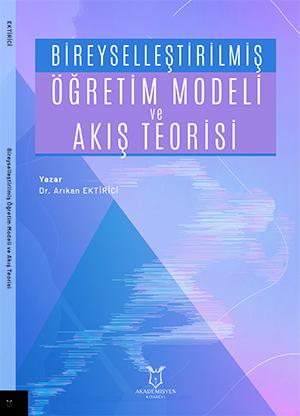
Bireyselleştirilmiş Öğretim Modeli ve Akış Teorisi
Özet
Bu kitap, Dr. Arıkan Ektirici tarafından kaleme alınmış ve bireyselleştirilmiş öğretim modeli ve akış teorisi konularını ele almaktadır. Kitap, Akademisyen Kitabevi A.Ş. tarafından basılmış olup, tüm yayın hakları bu kuruluşa aittir. Kitabın basım, yayın ve satış haklarına sahip olan kuruluşun izni olmadan kitabın tümü ya da bölümleri çoğaltılamaz, basılamaz veya dağıtılamaz. Tablo, şekil ve grafikler ticari amaçlı kullanılamaz. Kitap, bireyselleştirilmiş öğretim modeli ve akış teorisi konularını ele almakta olup, bu konularda yapılan bir doktora tezinden üretilmiştir. Kitapta yer alan fikirler ve düşünceler yazarın kendi görüşlerini yansıtmaktadır ve herhangi bir kurum veya kuruluşun görüşlerini yansıtmamaktadır. Kitap, beden eğitimi dersinde bireyselleştirilmiş öğretim modelinin akış teorisi çerçevesinde incelenmesini konu almaktadır. Kitabın amacı, beden eğitimi ve spor öğretmenlerini model temelli beden eğitimi konusunda bilinçlendirmek ve güncel öğretim yaklaşımlarının kullanımını yaygınlaştırmaktır.
This book, written by Dr. Arıkan Ektirici, addresses the topics of personalized instruction model and flow theory. The book is published by Akademisyen Kitabevi A.Ş. and all publishing rights belong to this organization. The entire book or its parts cannot be reproduced, printed, or distributed without the permission of the organization that holds the rights to its publication, distribution, and sale. Tables, figures, and graphics cannot be used for commercial purposes. The book focuses on the personalized instruction model and flow theory in the context of physical education and is derived from a doctoral thesis on these subjects. The ideas and thoughts presented in the book reflect the author's own views and do not represent the opinions of any institution or organization. The book examines the application of the personalized instruction model within the framework of flow theory in physical education classes. Its purpose is to raise awareness among physical education and sports teachers about model-based physical education and promote the use of current instructional approaches.
Referanslar
Ada, E. N., Çetinkalp, Z. K., Altiparmak, M. E., & Asci, F. H. (2018). Flow experiences in physical education classes: the role of perceived motivational climate and situational motivation. Asian Journal of Education and Training, 4(2), 114-120.
Ada, E. N., Comoutos, N., Karamitrou, A., & Kazak, Z. (2019). Relationships between dispositional flow, motivational climate, and self-talk in physical education classes. Physical Educator, 76(2), 357-384.
Addessi, A. R., Ferrari, L., Carlotti, S., & Pachet, F. (2006). Young children’s musical experiences with a flow machine. In Proceedings of the 9th International Conference on Music Perception and Cognition. Bologna: Alma Mater Studiorum University.
Adıgüzel, O. C. (2016). Eğitim Programlarını Geliştirilmesinde İhtiyaç Analizi El Kitabı. Ankara: Anı Yayıncılık.
Admiraal, W., Huizenga, J., Akkerman, S., & Ten Dam, G. (2011). The concept of flow in collaborative game based learning. Computers in Human Behavior, 27(3), 1185-1194.
Aksoy, G. K. ve Gürsel, F. (2017). The implementation of personal and social resposibility model in physical education classes: an action research. Education & Science/Egitim ve Bilim, 42(191), 415-431.
Alagül, Ö. (2015). Beden eğitiminde öğretmenlerin taktiksel oyun modeli deneyimleri: bir eylem araştırması. Yayımlanmamış doktora tezi. Ankara: Ankara Üniversitesi, Sağlık Bilimleri Enstitüsü.
Alter, M. J. (1998). Sport Stretching. Champaign, IL: Human Kinetics
Annarino, A. A. (1976). Individualized instructional materials. In Personalized learning in physical education (pp. 64-76). Washington DC: AAHPERD.
Asma, M. ve Soytürk, M. (2018). Farklı öğretim biçimleri ile gerçekleştirilen voleybol derslerinin öğrenme çıktıları açısından incelenmesi. Journal of Human Sciences, 15(2), 779-798.
Bae, H., & Yoo, P. K. (2012). The effects of learning based flow theory on scientific achievement and attitude toward science. Journal of the Korean Society of Earth Science Education, 5(3), 225-234.
Bakirtzoglou, P., Ioannou, P (2011). Goal orientations, motivational climate and dispositional flow in Greek secondary education students participating in physical education lesson: Differences based on gender. Series Physical Education and Sport, 9(3), 295–306
Başar, E. (2017). Türkiye’deki eğitimin tarihsel gelişimi. Demirel, Ö., & Kaya, Z. (Ed.), Eğitim bilimine giriş içinde (s. 23-66). Ankara: Pegem Atıf İndeksi.
Beylefeld, A. A., & Struwig, M. C. (2007). A gaming approach to learning medical microbiology: students’ experiences of flow. Medical Teacher, 29(9-10), 933-940.
Brankovic, E., & Hadzikadunic, M. (2017). Physical education experimental program to test the effect on perceived competence. Sport Mont, 15(2), 25-30.
Bucher, A. C., Koenig, C. R. (1983). Method and material for secondary school physical education. Saint Louis: The C.V. Mossey Company.
Büyüköztürk, Ş., Çakmak, E. K., Akgün, Ö. E., Karadeniz, Ş., & Demirel, F. (2017). Bilimsel araştırma yöntemleri. Ankara: Pegem Atıf İndeksi.
Byrne, B. M. (2010). Testing for the factorial validity of a theoretical construct. Structural equation modeling with AMOS: Basic concepts, applications, and programming. New York: Routledge.
Çelen, A. (2012). Spor eğitimi modeli ile işlenen voleybol derslerinin öğrencilerin bilişsel, duyuşsal ve psikomotor erişi düzeylerine etkisi. Yayınlanmamış Doktora Tezi. Ankara: Gazi Üniversitesi, Eğitim Bilimleri Enstitüsü.
Cervelló, E., Moreno, J.A., Alonso, N., & Iglesias, D. (2006). Goal orientations, motivational climate and dispositional flow of high school students engaging in extracurricular involvement in physical activity. Perceptual and Motor Skills, 102, 87–92.
Chapelle, C., & Jamieson, J. (1988). Research trends in computer-assisted language learning. M. Pennington (Ed.), Teaching languages with computers: The state of art içinde (s. 47-59). La Jolla, CA: Athelstan.
Cherubini, J., 2009. Positive psychology and quality physical education. Journal of Physical Education, Recreation & Dance, 80(7), 42-51.
Conti, R. (2001). Time flies: Investigating the connection between intrinsic motivation and the experience of time. Journal of Personality, 69(1), 1-26.
Cregger, R., & Metzler, M. (1992). PSI for a college physical education basic instructional program. Educational Technology, 51-56.
Creswell, J. W. (2015). Educational research: planning, conducting, and evaluating quantitative and qualitative research (5th Edition). Upper Saddle River, NJ: Pearson Education Inc.
Creswell, J. W. (2017). Karma yöntem araştırmalarına giriş. (Çev: Mustafa Sözbilir). Ankara: Pegem Akademi.
Csikszentmihalyi, M. (1988). The flow experience and its significance for human psychology. M. Csikszentmihalyi, & I. Csikszentmihalyi (Eds.). Optimal experience içinde (s. 15-35). Cambridge, UK: Cambridge University Press.
Csikszentmihalyi, M. (1990). Flow: The psychology of optimal experience. New York: Harper & Row.
Csikszentmihalyi, M. (2014). Applications of flow in human development and education. Dordrecht: Springer.
Csikszentmihalyi, M., Csikszentmihalyi, I.S. (1988). Introduction to Part IV. M. Csikszentmihalyi and I. S. Csikszentmihalyi (eds.), Optimal experience: Psychological studies of flow in consciousness içinde (s. 251-265). Cambridge, UK: Cambridge University Press.
Csikszentmihalyi, M., & Larson, R. (2014). Validity and Reliability of the Experience Sampling Method. M. Csikszentmihalyi (Ed.), Flow and the foundations of positive psychology içinde (s. 35-54). Dordrecht: Springer.
Csikszentmihalyi, M., Abuhamdeh, S., & Nakamura, J. (2014). Flow. M. Csikszentmihalyi (Ed.), Flow and the foundations of positive psychology içinde (s. 227-238). Dordrecht: Springer,
Cunha, J. C. R., & Carvalho, S. (2011). Orff-schulwerk approach and flow indicators in music education context:: a preliminary study in Portugal. International Journal of Arts & Sciences, 4(21), 75.
Cunha, J. C., & Carvalho, S. (2012). Experienced emotions through the orff-schulwerk approach in music education-a case study based on flow theory. Proceedings of 12th ICMPC/8th CESCSM, 234-241.
Custodero, L. A. (2002). Seeking challenge, finding skill: Flow experience and music education. Arts Education Policy Review, 103(3), 3–9.
Darst, W.P. and Pangrazi. R.P. (2006). Dynamic physical education for secondary school students. San Francisco: Pearson Benjamin Cummings.
Deci, E. L., & Ryan, R. M. (1987). The support of autonomy and the control of behavior. Journal of personality and social psychology, 53(6), 1024.
Demirel, Ö. (2002). Eğitimde program geliştirme: kuramdan uygulamaya. Ankara: Pegem A Yayıncılık.
Denzin, N. K. (1978). Sociological Methods: A Sourcebook. (2nd Edition). New York: McGraw Hill.
Dönmez, A. (2018). Beden eğitimi ve spor öğretmenlerinin kullandıkları öğretim yöntemleri ve kişilik özelliklerinin belirlenmesi (Sakarya İl Örneği). Yayımlanmamış Yüksek Lisans Tezi. Sakarya: Sakarya Üniversitesi, Eğitim Bilimleri Enstitüsü.
Doydu, İ., Çelen, A. ve Çoknaz, H. (2013). Spor eğitimi modeli’nin öğrencilerin beden eğitimi ve spora karşı tutumuna etkisi/the effect of the sports education model on the attitudes of students towards physical education and sports. E-Uluslararası Eğitim Araştırmaları Dergisi, 4(2), 99-110.
Egbert, J. (2004). A study of flow theory in the foreign language classroom. Canadian Modern Language Review, 60(5), 549-586.
Ertürk, S. (2013). Eğitimde “program” geliştirme (6. basım). Ankara: Edge Akademi.
Everett, M. W., & Raven, M. R. (2015). A case study of flow theory in pre-service undergraduate agriculture, food and natural resources education students. NACTA Journal, 59, 144–148.
Ferah, A. (2015). Basketbol Oyunları. Ankara: Spor Yayınevi ve Kitabevi.
Fraenkel, J. R., Wallen, N. E., & Hyun, H. H. (2012). How to design and evaluate research in education. New York: McGraw-Hill Humanities/Social Sciences/Languages.
Gallahue, D. L. (1999). Developmental physical education for today’s children. USA: Brown and Benchmark Publishers.
Ghani, J. A. (1995). Flow in human-computer interactions: test of a model. J. M. Carey (Editör), Human factors in information systems: emerging theoretical bases içinde (s. 291– 309). NJ: Ablexi Norwood
González-Cutre, D., Sicilia, Á., Moreno, J. A., & Fernández-Balboa, J. M. (2009). Dispositional flow in physical education: relationships with motivational climate, social goals, and perceived competence. Journal of Teaching in Physical Education, 28(4), 422-440.
Güllü, M. (2016). Beden eğitimi öğretmenlerinden öğrencilerin beklentileri. Ankara: Spor Yayınevi ve Kitabevi.
Gültekin, M. (2010). Eğitimin tarihsel temelleri. Gültekin, M. (Editör), Eğitim bilimine giriş içinde (s. 113-132). Eskişehir: Anadolu Üniversitesi Yayını.
Güneş, B. (2017). Bireyselleştirilmiş öğretim modeli (BÖM). Mirzeoğlu, A.D. (Editör), Model temelli beden eğitimi öğretimi içinde (s. 50-77). Ankara: Spor Yayınevi ve Kitabevi.
Güriş, S., & Astar, M. (2014). Bilimsel araştırmalarda SPSS ile istatistik. Ankara: Der Yayınları.
Gurvitch, R., & Metzler, M. (2010). Theory into practice: keeping the purpose in mind: the implementation of instructional models in physical education settings. Strategies, 23(3), 32-35.
Hannon, J. C., Holt, B. J., & Hatten, J. D. (2008). Personalized systems of instruction model: teaching health-related fitness content in high school physical education. Journal of Curriculum and Instruction, 2(2), 20-33.
Hansen, L. (2009). Fifth grade students’experiences participating in active gaming during physical education classes. Unpublished doctoral dissertation, University of South Florida
Harmison, R. J. and Casto, K. V. (2012). Optimal performance: Elite level performance in “the zone”. S. M. Murphy (Ed.), Oxford library of psychology. The Oxford handbook of sport and performance psychology içinde (s. 707-724). England: Oxford University Press.
Heper, E. (2012). Spor bilimleri ile ilgili kavramlar ve sporun tarihsel gelişimi. Ertan, H. (Editör), Spor bilimlerine giriş içinde (s. 2-30). Eskişehir: Açıköğretim Fakültesi Yayını No: 1480.
Hsieh, Y. H., Lin, Y. C., & Hou, H. T. (2016). Exploring the role of flow experience, learning performance and potential behavior clusters in elementary students’ game-based learning. Interactive Learning Environments, 24(1), 178-193.
Hsu, C. L. and Lu, H. P. (2004). Why do people play online games? An extended TAM with social influences and flow experience. Information and Management, 41, 853–868.
Hu, L. T., & Bentler, P. M. (1999). Cutoff criteria for fit indexes in covariance structure analysis: conventional criteria versus new alternatives. Structural Equation Modeling, 6(1), 1-55.
İnce, M. L. ve Hünük, D. (2010). Eğitim reformu sürecinde deneyimli beden eğitimi öğretmenlerinin kullandıkları öğretim stilleri ve stillere ilişkin algıları. Eğitim ve Bilim, 35(157), 128-139.
İşigüzel, B., & Çam, S. (2014). Flow Yaşantısı Ölçeği Kısa Formunun Türkçeye uyarlama, geçerlik ve güvenirlik çalışması. Journal of Human Sciences, 11(2), 788-801.
Jackson, S.A. and H.W. Marsh, 1996. Development and validation of a scale to measure optimal experience: the flow state scale. Journal of Sport and Exercise Psychology, 18(1), 17-35.
Jackson, S.A., 1996. Toward a conceptual understanding of the flow experience in elite athletes. Research Quarterly for Exercise and Sport, 67(1), 76-90.
Jentsch D., Riedel R., Mueller E. (2013). Flow and physical objects in experiential learning for ındustrial engineering education. Emmanouilidis C., Taisch M., Kiritsis D. (Eds) Advances in Production Management Systems. Competitive Manufacturing for Innovative Products and Services. APMS 2012. IFIP Advances in Information and Communication Technology, vol 397 içinde (s. 566-573). Springer, Berlin, Heidelberg.
Kane, M. (1994). Validating the performance standards associated with passing scores. Review of Educational Research, 64(3), 425-461.
Kangalgil, M., Kural, T., Coşkun, F. (2014). Basketbol El Kitabı. Ankara: Spor Kitabevi ve Yayınevi.
Kawabata, M., & Mallett, C. J. (2016). What is flow?: reconsideration of the state of optimal functioning beyond flow theory. R. J. Schinke, B. Smith, & K. McGannon (Eds.). Routledge international handbook in sport psychology içinde (s. 369–377). New York: Routledge.
Keller, F. S. (1968). Goodbye teacher! Journal of Applied Behavior Analysis, 1(1), 79-89.
Keller, F. S., & Sherman, J. G. (1974). PSI, the Keller plan handbook: essays on a personalized system of instruction. WA Benjamin Advanced Book Program.
Keske, A. G. ve Gürsel, F. (2015). Modele dayalı uygulamada beden eğitimi öğretmenini güçlendiren ve yavaşlatan ögeler. Spormetre Beden Eğitimi ve Spor Bilimleri Dergisi, 13(1), 73-82.
Kiili, K. (2005). Content creation challenges and flow experience in educational games: The IT-emperor case. The Internet and Higher Education, 8, 183–198.
Kiili, K., De Freitas, S., Arnab, S., & Lainema, T. (2012). The design principles for flow experience in educational games. Procedia Computer Science, 15, 78-91.
Koca, C. (2017). Spor bilimlerinde nitel araştırma yaklaşımı. Spor Bilimleri Dergisi, 28(1), 30-48.
Kowal, J., & Fortier, M.S. (2000). Testing relationships from the hierarchical model of intrinsic and extrinsic motivation using flow as a motivational consequence. Research Quarterly for Exercise and Sport, 71, 171–181.
Liao, L. F. (2006). A flow theory perspective on learner motivation and behavior in distanceeducation. Distance Education, 27(1), 45-62.
Lowry, W. H., & Thornburg, M. S. (1988). A working bibliography on the Keller plan (PSI). Logan, UT: Author.
MacDonald, R., Byrne, C., & Carlton, L. (2006). Creativity and flow in musical composition: An empirical investigation. Psychology of Music, 34(3), 292-306.
McQuillan, J., & Conde, G. (1996). The conditions of flow in reading: Two studies of optimal experience. Reading Psychology: An International Quarterly, 17, 109-135.
Metzler, M. (1984). Analysis of a mastery learning/personalized system of instruction for teaching tennis. In The 1984 Olympic scientific congress proceedings (Vol. 6, pp. 63-70).
Metzler, M. (1986). Teaching tennis by the Keller method: a comparison between” traditional” and PSI-based instruction. In Annual Meeting of the American Educational Research Association, San Francisco, CA.
Metzler, M., Eddleman, K., Treanor, L., & Cregger, R. (1989). Using a personalized system of ınstruction for teaching tennis. In meeting of Eastern Educational Research Association, Savannah, GA.
Metzler, Michael W. (2005). Instructional models for physical education (2nd edition). Arizona: Hollcomb Hataway Publishers.
Meydan, C. H., & Şeşen, H. (2015). Yapısal Eşitlik Modeli AMOS Uygulamaları. Ankara: Detay Yayıncılık.
Meyer, A., Klingenberg, K., & Wilde, M. (2016). The benefits of mouse keeping an empirical study on students’ flow and intrinsic motivation in biology lessons. Research in Science Education, 46(1), 79-90.
Mirzeoğlu, A. D. (2017). Model temelli beden eğitimi öğretimi. Ankara: Spor Yayınevi.
Mirzeoğlu, A. D. (2017). Temel kavramlar. Mirzeoğlu, A.D. (Editör), Model temelli beden eğitimi öğretimi içinde (s. 9-25). Ankara: Spor Yayınevi ve Kitabevi.
Nakamura, J., & Csikszentmihalyi, M. (2002). The concept of flow. C. R. Snyder, & S. J. Lopez (Eds.). Handbook of positive psychology içinde (s. 89–105). New York: Oxford University Press.
Nalbant, Ö. (2013). Farklı Bakış Açılarıyla Bilinen ve Bilinmeyen Yönleriyle Basketbol. Ankara: Nobel Akademik Yayıncılık Eğitim Danışmanlık Tic. Ltd. Şti.
Newcomb, L.J., J. McCracken, J. Warmbrod and M. Whittington (2003). Methods of teachingagriculture. Saddle River, NJ: Prentice Hall.
Ntoumanis, N. (2005). A prospective study of participation in optional school physical eduction using a self-determination theory framework. Journal of Educational Psychology, 97, 444–453.
Ntoumanis, N., 2001. A self-determination approach to the understanding of motivation in physical education. British Journal of Educational Psychology, 71(2), 225-242.
Oğuzhan, N. S. (2019). Ortaokul öğrencilerinin spor eğitim modeline ilişkin deneyimleri: boylamsal bir çalışma. Yayımlanmamış Yüksek Lisans Tezi. Denizli: Pamukkale Üniversitesi, Eğitim Bilimleri Enstitüsü.
Oğuzhan, N. S. ve Hünük, D. (2017). Experiences of students with special needs on sport education model. Journal of Education and Training Studies, 5(13), 70-78.
Pangrazi, P. R. (2007). Dynamic physical education for elementary school children. San Francisco: Pearson Benjamin Cummings.
Pangrazi, R. P., Beighle, A. (2016). Dynamic physical education for elementary school children (18th ed.). San Francisco: Pearson Education, Inc.
Parr, G. D., Montgomery, M., & DeBell, C. (1998). Flow theory as a model for enhancing student resilience. Professional School Counseling, 1(5), 26–31.
Pates, J., & Maynard, I. (2000). Effects of hypnosis on flow states and golf performance. Perceptual and Motor Skills, 91(3_suppl), 1057-1075.
Pear, J., Schnerch, G., Silva, K., Svenningsen, L., & Lambert, J. (2011). Web-based computer-aided personalized system of instruction. New Directions or Teaching and learning, 128, 85- 94
Pharez, E.S. (2016). Enjoyment fosters engagement: the key to involving middle school students in physical education and physical activity. Journal of Physical Education, Recreation & Dance, 87(6), 24-28.
Pritchard, T., Penix, K., Colquitt, G., & McCollum, S. (2012). Effects of a weight training personalized system of instruction course on fitness levels and knowledge. Physical Educator, 69(4), 342-359.
Rathunde, K. (2003). A comparison of Montessori and traditional middle schools: Motivation, quality of experience, and social context. NAMTA Journal, 28(3), 13–52.
Rheinberg, F., Vollmeyer, R., & Engeser, S. (2003). Die erfassung des flow-erlebens [the assessment of flow experience]. J. Stiensmeier-Pelster, & F. Rheinberg (Eds.), Diagnostik von Selbstkonzept, Lernmotivation und Selbstregulation [Diagnosis of Motivation and Self-Concept] içinde (s. 261-279). Göttingen: Hogrefe.
Rink, J. E. (2006). Teaching physical education for learning (5th ed.). New York, NY: McGraw-Hill.
Rodríguez-Ardura, I., & Meseguer-Artola, A. (2016). E-learning continuance: The impact of interactivity and the mediating role of imagery, presence and flow. Information & Management, 53(4), 504-516.Rukavina, P.B. and S.A. Doolittle, 2016. Fostering inclusion and positive physical education experiences for overweight and obese students. Journal of Physical Education, Recreation &Dance, 87(4), 36-45.
Savaş, M. Ş. (2018). Taktiksel oyun yaklaşımının ortaokul öğrencilerinin yaratıcılık düzeylerine etkisinin incelenmesi. Yayımlanmamış Tüksek lisans Tezi. Aksaray: Aksaray Üniversitesi, Sosyal Bilimler Enstitüsü.
Schmidt, R. (1993). Awareness and second language acquisition. Annual Review of Applied Linguistics, 13, 206-226.
Schmidt, R., Boraie, D., & Kassabgy, O. (1996). Foreign language motivation: Internal structure and external connections. R. Oxford (Ed.), Language learning motivation: Pathways to the new century içinde (s. 1-72). Manoa: University of Hawai‘i Press.
Senemoğlu, N. (2005). Gelişim öğrenme ve eğitim: kuramdan uygulamaya (12. basım). Ankara:Gazi Kitabevi.
Shernoff, D. J., Csikszentmihalyi, M., Shneider, B., & Shernoff, E. S. (2003). Student engagement in high school classrooms from the perspective of flow theory. School Psychology Quarterly, 18, 158–176.
Shin, N. (2006). Online learner’s ‘flow’experience: an empirical study. British Journal of Educational Technology, 37(5), 705-720.
Siedentop, D. (1973). How to use personalized systems of instruction in college teaching. NC PEAM Proceedings, 116-125.
Sinnamon, S., Moran, A., & O’Connell, M. (2012). Flow among musicians: Measuring peak experiences of student performers. Journal of Research in Music Education, 60(1), 6-25.
Smith, J. S. (2005). Flow theory and GIS: Is there a connection for learning? International Research in Geographical and Environmental Education, 14, 225–230.
Snyder, B., & Tardy, C. (2001). ‘That’s why I do it’: flow and teachers’values, beliefs, and practices. Paper presented at TESOL Annual Convention. St. Louis, MO.
Stormoen, S., Urke, H. B., Tjomsland, H. E., Wold, B., & Diseth, Å. (2016). High school physical education: what contributes to the experience of flow?. European Physical Education Review, 22(3), 355-371.
Taşpınar, M., ve Atıcı, B. (2002). Öğretim model, strateji, yöntem ve becerileri/teknikleri: Kavramsal boyut. Eğitim araştırmaları, 2(8), 207-215.
Vaghetti, C. A., Duarte, M. A., Ribeiro, P. O., & Botelho, S. S. (2012). Using exergames as social networks: testing the flow theory in the teaching of physical education. In Brazilian Symposium on Computers in Education (Simpósio Brasileiro de Informática na Educação-SBIE), 23(1).
Vieira, AL (2011). Interactive LISREL in Practice. Berlin: Springer.
Weinberg, R. S, Gould, D. (2015). Spor ve Egzersiz Psikolojisinin Temelleri (Çev: M. Şahin ve Z. Koruç,). Ankara: Nobel Yayıncılık.
Whalen, S. P. (1998). Flow and the engagement of talent: implications for secondary schooling. National Association of Secondary School Principals, NASSP Bulletin, 82(595), 22–37.
Wrigley, W. J., & Emmerson, S. B. (2011). The experience of the flow state in live music performance. Psychology of Music, 41, 292–305.
Wuest, D. A., Bucher, C. A. (1999). Foundations of physical education and sport. Usa: Mcraw-Hill Companies.
Yaşar, Ş. (2011). Öğretmenlik Mesleği ve Öğretmenin Nitelikleri. Gültekini M. (Editör), Eğitim Bilimine Giriş içinde (s. 181-192). Eskişehir: Anadolu Üniversitesi Yayını No:1825.
Yeşilyaprak, B. (1997). Eğitim programlarının geliştirilmesinde öğretmenin rolü, uluslararası dünya öğretmen eğitimi konferansı. Ankara: Milli Eğitim Basımevi.
Yıldırım, A. & Şimşek, H. (2016). Sosyal bilimlerde nitel araştırma yöntemleri. Ankara: Seçkin Yayıncılık.
Yüksel, H. S., & Tuncel, F. (2017). Experiences of 5th grade students participating in active gaming-assisted physical education lessons. Journal of Education and Training Studies, 5(13), 19-31.
http-1: http://oygm.meb.gov.tr/meb_iys_dosyalar/2017_12/11115355_YYRETMENLYK_MESLEYY_GENEL_YETERLYKLERY.pdf (Erişim tarihi: 21.10.2019).
http-2: http://mufredat.meb.gov.tr/Dosyalar/2018120201950145-BEDEN%20EGITIMI%20VE%20SPOR%20OGRETIM%20PROGRAM%202018.pdf (Erişim tarihi: 21.10.2019).
Yayınlanan
Lisans
LisansBu İnternet Sitesi içeriğinde yer alan tüm eserler (yazı, resim, görüntü, fotoğraf, video, müzik vb.) Akademisyen Kitabevine ait olup, 5846 sayılı Fikir ve Sanat Eserleri Kanunu ve 5237 sayılı Türk Ceca Kanunu kapsamında korunmaktadır. Bu hakları ihlal eden kişiler, 5846 sayılı Fikir ve Sanat eserleri Kanunu ve 5237 sayılı Türk Ceza Kanununda yer alan hukuki ve cezai yaptırımlara tabi olurlar. Yayınevi ilgili yasal yollara başvurma hakkına sahiptir.